Leer en español: Michael Kenna: quitar en el espacio, sumar en el tiempo
Michael Kenna (Widnes, England, 1953) has photographed in black and white, on medium format film and almost always square, for five decades. He prefers night, dawn, fog and snow, and his exposures run from a few minutes to several hours. He prints every copy himself in a darkroom, on small paper. A photograph of his is easy to recognise and easy to imitate badly, because what gets copied is the look: the smooth water, the lone tree, the emptiness.
This article gathers what you see when you look at him more slowly and from several sides at once: what photography does when it takes away and when it adds, what is left of an object once it stops looking like itself, what part the atmosphere and the print play, and what a long exposure is physically. At the end there are readings and a few questions I am still asking myself.
Taking away in space, adding in time
Michelangelo distinguished between sculpture made “per forza di levare”, by taking material away, and sculpture made “per via di porre”, by adding it, which he thought closer to painting. Photography is on the side of the first. The photographer does not make what appears in the picture: he decides which part of the world goes into the rectangle and which part stays out. John Szarkowski put it in order in The Photographer’s Eye with five ideas: the thing itself, the detail, the frame, time and vantage point.
With Kenna the metaphor falls short. He takes away colour, detail and context, but in a long exposure he also adds: accumulated time. The resulting image never existed at any particular instant; it is an integral the eye cannot perform. Then, in the darkroom, he interprets again with tone, the density of the blacks and the cleanness of the whites. Photography takes away in space and can add in time.
Simple is not the same as minimalist
Donald Judd’s minimalism sought objects that referred to nothing outside themselves. Kenna is at the opposite end: his photographs are loaded with references, memory, melancholy and human traces, like the towers of Ratcliffe power station or the torii rising out of the water in Japan. What he reduces is visual noise, and the meaning stays or even concentrates. That is why “simple” describes his work better than “minimalist”. A photograph can be full of elements and still be simple, if all of them obey a single idea.
What is left when the chair stops being a chair
Charles S. Peirce distinguishes three ways in which a sign refers to something: by resemblance (the icon), by convention (the symbol) and by physical connection (the index). A photograph is icon and index at once: it looks like what it shows and, besides, the light that bounced off it reached the film or the sensor.
If you photograph a chair by getting closer and taking away until only textures and traces are left, you lose the icon, because the image no longer looks like a chair, and you lose the symbol, because nobody would say “chair” on seeing it. But the index remains: the light bounced off that wood. That is why photographic abstraction never reaches the pure sign. There is always the residue Roland Barthes called “that has been”, and it makes a photographic abstraction unsettling in a different way from a painted one.
That path has a tradition: Alfred Stieglitz’s Equivalents, clouds he wanted read as music; Aaron Siskind’s walls and peeling paint; Minor White. To see where the index breaks there are the photograms of Man Ray and László Moholy-Nagy and the chemigrams of Pierre Cordier, images made without a camera. An image generated by artificial intelligence does exactly the opposite: it keeps the resemblance and loses the physical connection. Photography is the only medium in which you can lose the resemblance and keep the connection.
Four photographs
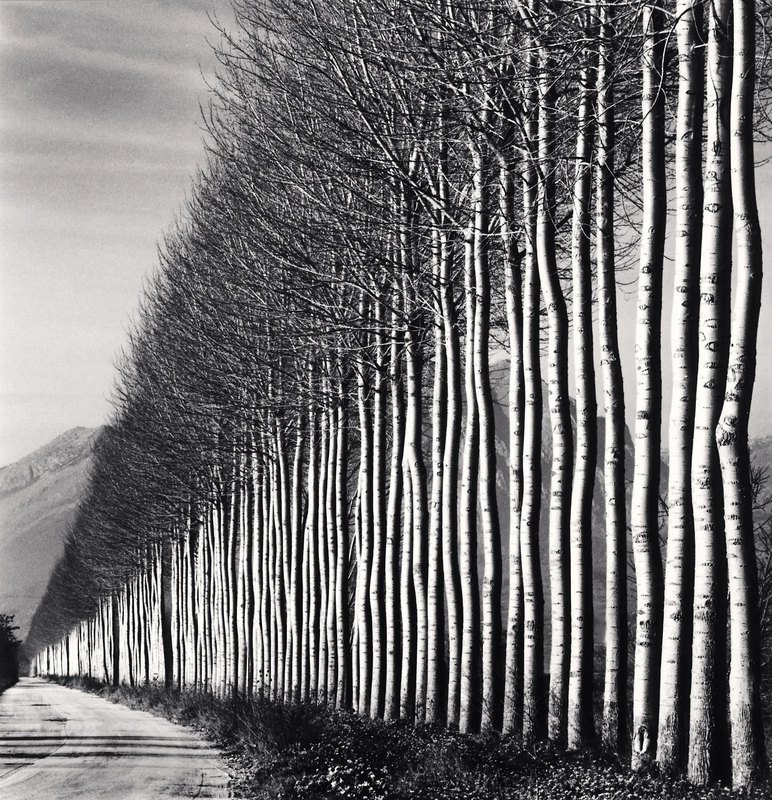
In a row of poplars like Poplar Trees, Fucino, Abruzzo (2016) the picture is full of trees, and still it is simple. The simplicity comes from repetition, shrinking towards the vanishing point like a musical bar. The road is reduced to a strip in the corner so that the subject is the rhythm.
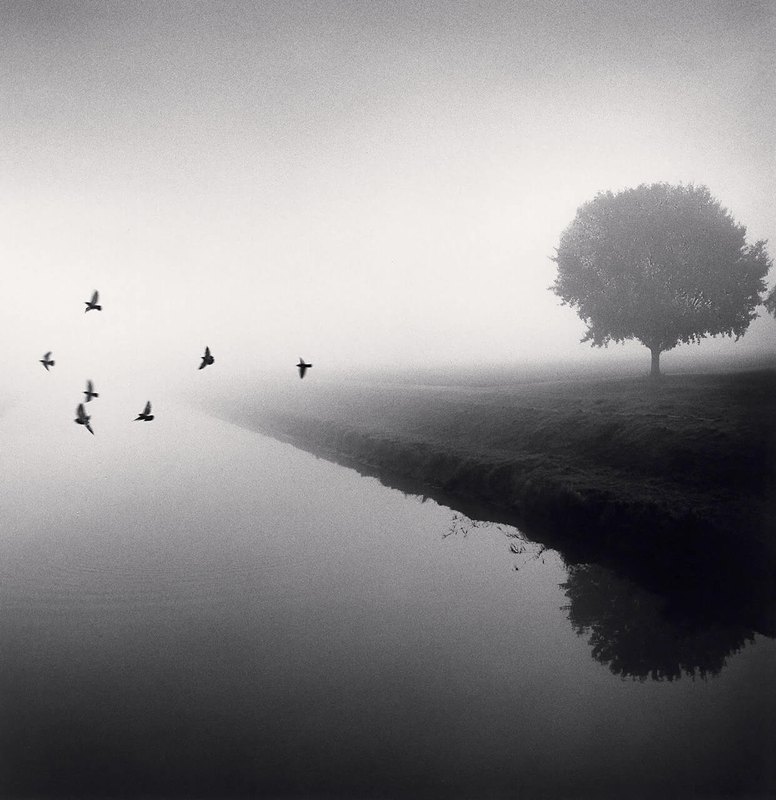
In Ponti di Spagna, Bondeno, Ferrara (2018), birds cross a canal in fog and half the frame is empty. A tree and its reflection close the right-hand side and the birds fly out into the void. Two times coexist in the same image: the still water and the fog, which barely change during the exposure, and the birds, with blurred wings.
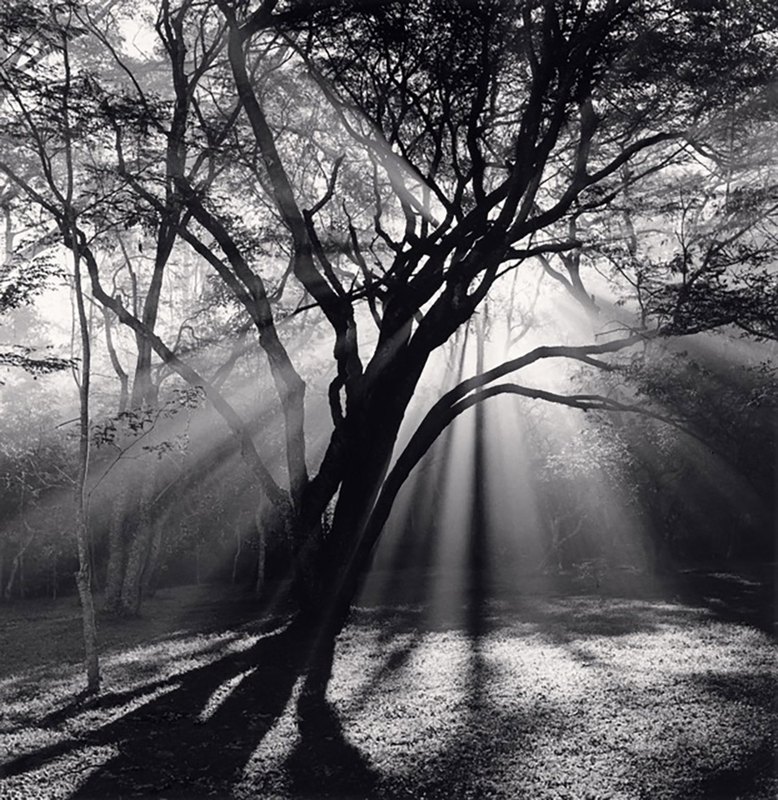
In the backlit trees of Sun Rays in Trees, Study 2, Pyin U Lwin (2019) the real subject is the air. The rays are visible only because there are particles scattering the light: Kenna photographs the medium the light travels through.
In the tree on Lake Kussharo, in Hokkaido (Kussharo Lake Tree, Study 6, 2007), the snow and the white sky erase the ground and the horizon, and the tree is left as a stroke of calligraphy, a single slanting gesture that generates all the tension. It became so well known that people climbed on it, and it was cut down in 2009.
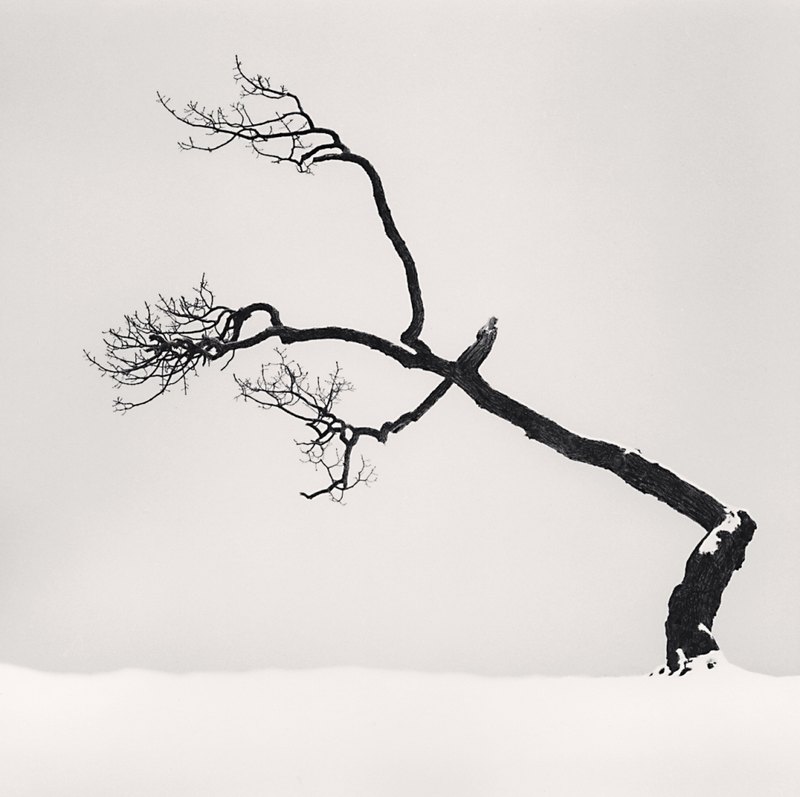
Two constants come out of the four. The first is that Kenna rarely removes things himself: he waits for the atmosphere to do it. Fog, snow, backlight and night work as an eraser. The second is the square format, which has no preferred direction and forces the content to create the tension.
There is a simple exercise for looking at them: imagine each photograph on a clear day in full sun. The ones that survive, like the poplars, depend on form. The ones that vanish depend on atmosphere.
Atmosphere needs an anchor
You could say that Kenna photographs an atmosphere rather than a composition, and that he is so good he composes well too. One nuance has to be added: atmosphere needs an anchor. Without the tree, the fog in the photograph of the birds would be a uniform grey. A dark, well-defined element gives scale to the emptiness, and deciding where it goes, how large it is and how much space surrounds it is composition.
In Japanese, Ma is the interval, the space between things with a value of its own. As in music, a silence exists only because there are notes around it, and Kenna composes the silences. He also goes back to the same places many times, sometimes over years. He has the frame worked out before the fog arrives: first he finds the place, then he waits for the atmosphere to do the rest.
The print is half the work
In his Darkroom Diaries, published in On Landscape in 2025, Kenna explains how he works. He prints on Ilford Multigrade fibre paper, a cold-tone paper he warms slightly with sepia toner. A print can take him several hours in the darkroom and several more of retouching by hand, and some images have needed a dozen working prints. Each print carries so much dodging and burning that no two are alike.
The most revealing part is how he thinks about that work. He speaks of light as a sculptural tool: darkening an area of the print pulls it forward and lightening it pushes it back into the emulsion. And he speaks of balance in terms of mechanics: a balanced print always has a centre of gravity. Michelangelo’s sculpture is in the darkroom too, and there it works by hand. The fog in his photographs is partly atmosphere and partly print.
The digital equivalents are fairly direct. The raw file is the negative. The global curve and contrast stand for the paper grade and the base exposure. Local masks are dodging and burning. And a warm split toning in the highlights and midtones reproduces sepia on a cold paper.
There is one important physical difference. Film has a shoulder in its characteristic curve and compresses the highlights gently, which gives those fog whites that keep their texture. A sensor is linear until it saturates, and there it cuts off sharply. In digital you have to protect the highlights when shooting and build the shoulder by hand with the curve.
The hardest thing to carry over is the print-by-print decision. Some habits get you closer: develop several versions and choose; think of masks as near and far rather than light and dark; print small, about 20 by 20 centimetres, on baryta paper; and come back to the image a few days later. The small size matters because it makes you come close, and that distance is part of the reading.
The long exposure as a temporal low-pass filter
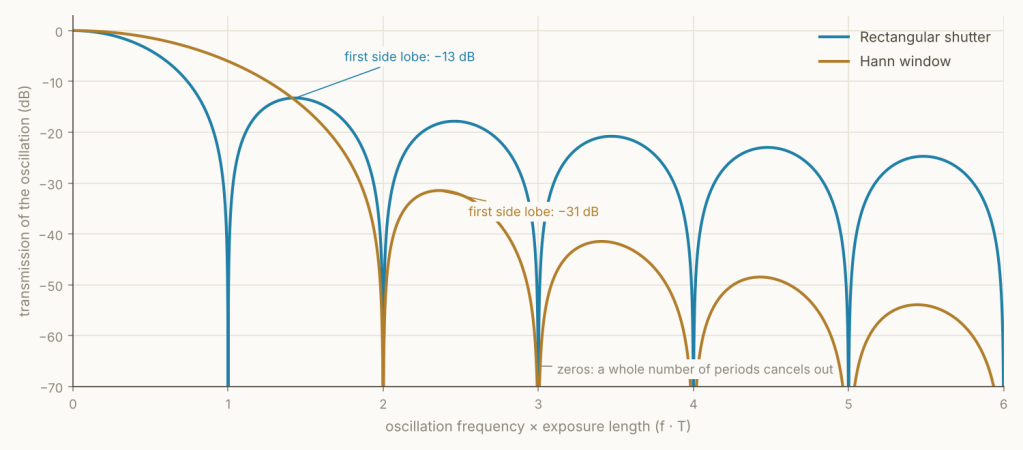
For a fixed point of the image, the exposure is the integral of the light arriving while the shutter is open. If the shutter opens and closes abruptly, the window w(t) is a rectangle of length T, and its frequency response is a sinc:
I(x) = ∫ E(x, t) w(t) dt → |H(f)| = |sin(πfT) / (πfT)|
The cut-off is around 1/T. Whatever fluctuates faster gets averaged: waves, with periods of seconds, vanish in an exposure of minutes and the sea is reduced to its constant component.
The filter acts point by point. When something travels across the image, it stops being only temporal: the integral becomes a spatial convolution along the trajectory. That is why stars turn into trails. A long exposure flattens what oscillates in place and turns what travels into a stroke.
It also erases. A person who crosses the frame in two seconds during a ten-minute exposure contributes 2/600 of the light at the points they pass through, and is invisible. Accumulated time keeps what persists and removes what passes. For a photographer of memory and traces, the tool is a filter that lets through only what lasts. Barthes said “that has been”; of Kenna one would have to say “that has lasted”.
Two physical nuances. The rectangular window has side lobes: if the exposure spans a whole number of periods of an oscillation, it cancels out, and if not, it leaves a residue. And film suffers reciprocity failure in long exposures, with a response of roughly E · tp with p below 1: faint areas register less and highlights dominate more. Kenna’s filter is not even linear, and that contributes to his highlights floating over dense shadows.
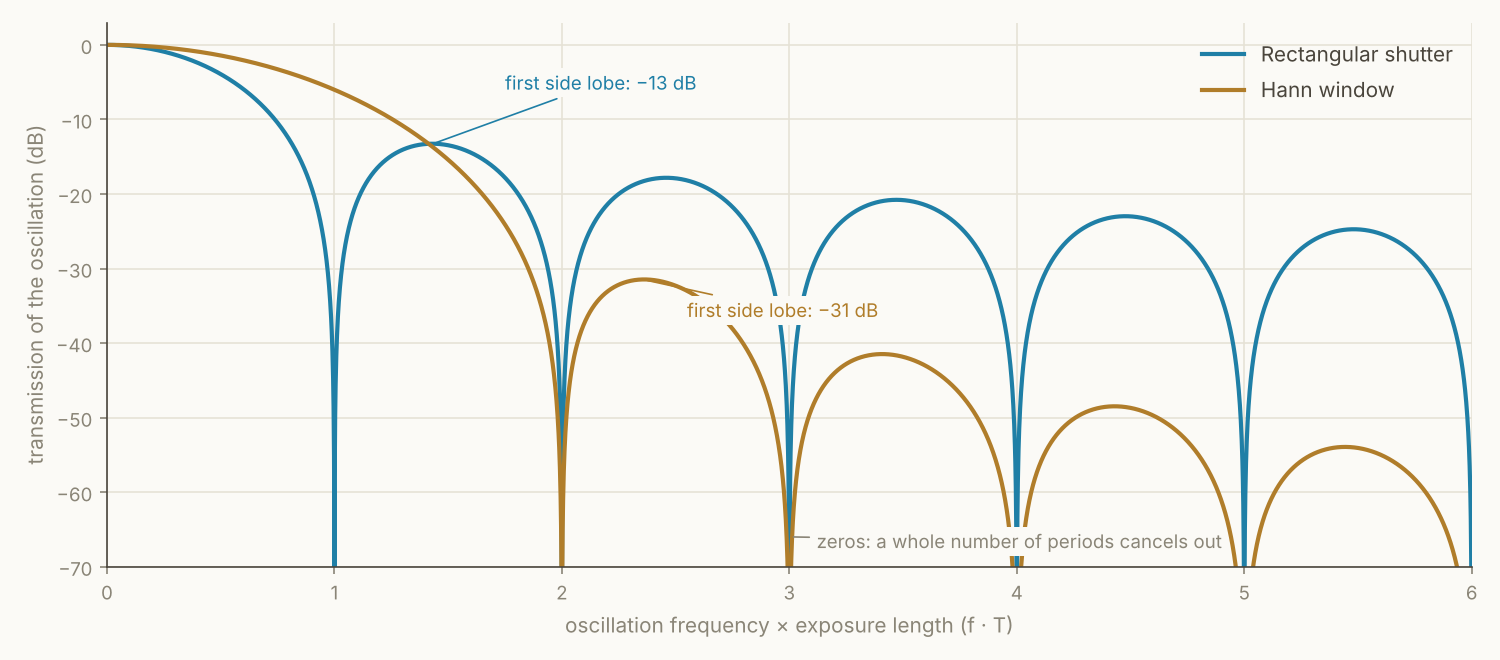
In digital you can shoot a sequence from the tripod and choose the operator afterwards. The mean reproduces the classic long exposure. The median is a robust estimator that removes the transient instead of averaging it. The maximum gives trails. And a mean weighted with a Hann window removes the side lobes of the sinc. Choosing the operator becomes an aesthetic decision. I implemented it in the temporal stack of my tools for Capture One, and the arithmetic of the time needed for a given blur is in the lab’s long exposure calculator.
At the other end is Henri Cartier-Bresson. The decisive moment is almost sampling with a delta: it lets every frequency through and bets on the exact phase. Kenna and he are the two poles of the same variable. To see the integral taken to the limit there are Hiroshi Sugimoto’s Theaters, a whole film in a single frame, and Michael Wesely’s years-long exposures of the rebuilding of Potsdamer Platz in Berlin.
Mean and median, two ways of treating time
The mean is a physical exposure: each frame contributes in proportion to its duration, and everything that happened leaves a trace. As an estimator it is sensitive to extreme values. The median is a vote: at each point, whatever was present more than half the time wins, and the rest disappears without a ghost. No shutter can produce a median: it is an image that never existed at any instant, nor as a sum.
In the same scene the difference shows up in four places:
- Whatever passes through. The mean leaves ghosts with an opacity equal to the fraction of time they were there, and a car headlight leaves a trail even if it passes quickly. The median erases them. Daguerre’s Boulevard du Temple, from 1838, is a mean: the street comes out empty because passers-by contributed too little light to register, except the man who stood still while his boots were being polished.
- Water with glints. Its distribution is skewed, dark most of the time with flashes. The mean gives a silvery, shining sea; the median, matte water.
- Moving edges. The mean draws the distribution of the edge’s position, a gradient whose width is the amplitude of the movement; the median puts a step at the median position. The mean draws the uncertainty and the median makes a decision, which is why clouds come out as a veil in the mean and as blotches in the median.
- Noise. The median is less efficient: its deviation is √(π/2) ≈ 1.25 times that of the mean, so it needs 57 % more frames to come out equally clean. The sigma operator combines the two: it discards the exceptional and averages the rest.
In Michelangelo’s terms, the mean adds in time and the median takes away. If of Kenna one can say “that has lasted”, the median would say “that was the usual” and the maximum “that shone at some point”. The decisive moment is the delta.
It works as a provisional reading of my own way of looking. Kenna fascinates me, and he is a mean. The idea of taking a chair down to the sign is a median operation. And most of the photographers I admire belong to the delta: Alex Webb, Garry Winogrand, Joel Meyerowitz, Cartier-Bresson, Vivian Maier, Fan Ho. The bet I still have to test is the sigma operator, which removes the exceptional and keeps the gradients, like Kenna with a chisel. The test is simple: a sequence of about forty frames with water, people and sky, processed with mean, median and sigma, writing down beforehand which one I think I will choose.
For further reading and looking
- John Szarkowski, The Photographer’s Eye.
- Roland Barthes, Camera Lucida, and Philippe Dubois, L’Acte photographique, which develops photography as a trace in Peirce’s sense.
- Rosalind Krauss, “Notes on the Index”.
- Lyle Rexer, The Edge of Vision, on abstraction in photography.
- Alfred Stieglitz, Equivalents; Aaron Siskind and Minor White; Man Ray, Moholy-Nagy and Pierre Cordier.
- Junichiro Tanizaki, In Praise of Shadows, for Kenna’s Japanese side; Masao Yamamoto, Small Things in Silence; Edward Weston and Harry Callahan, the object taken to form without ceasing to be an object.
- Ansel Adams, The Print; Tim Rudman on black and white printing techniques; Phil Davis, Beyond the Zone System, which treats sensitometry with characteristic curves.
- Vilém Flusser, Towards a Philosophy of Photography: the camera as an apparatus with a programme. Kenna works exactly where the camera’s programme stops being useful, with hours-long exposures, night, fog, film and hand printing. The lab has a sheet on the camera’s programme.
His website has an almost complete archive, with an alphabetical title index, and an interview about his work in the darkroom.
And the questions I am still asking myself:
- Which kind of image do I lean towards, the one that depends on form or the one that depends on atmosphere?
- How far can the extraction of the chair go before the photograph loses interest, and what holds it up once the object can no longer be recognised?
- Where is my camera’s programme deciding for me, and under what conditions could I play against it?
- What will I choose in the mean, median and sigma test, and will it match what I bet on?


Deja una respuesta