Leer en español: Exposición larga: cómo calcular el tiempo a partir del arrastre que buscas
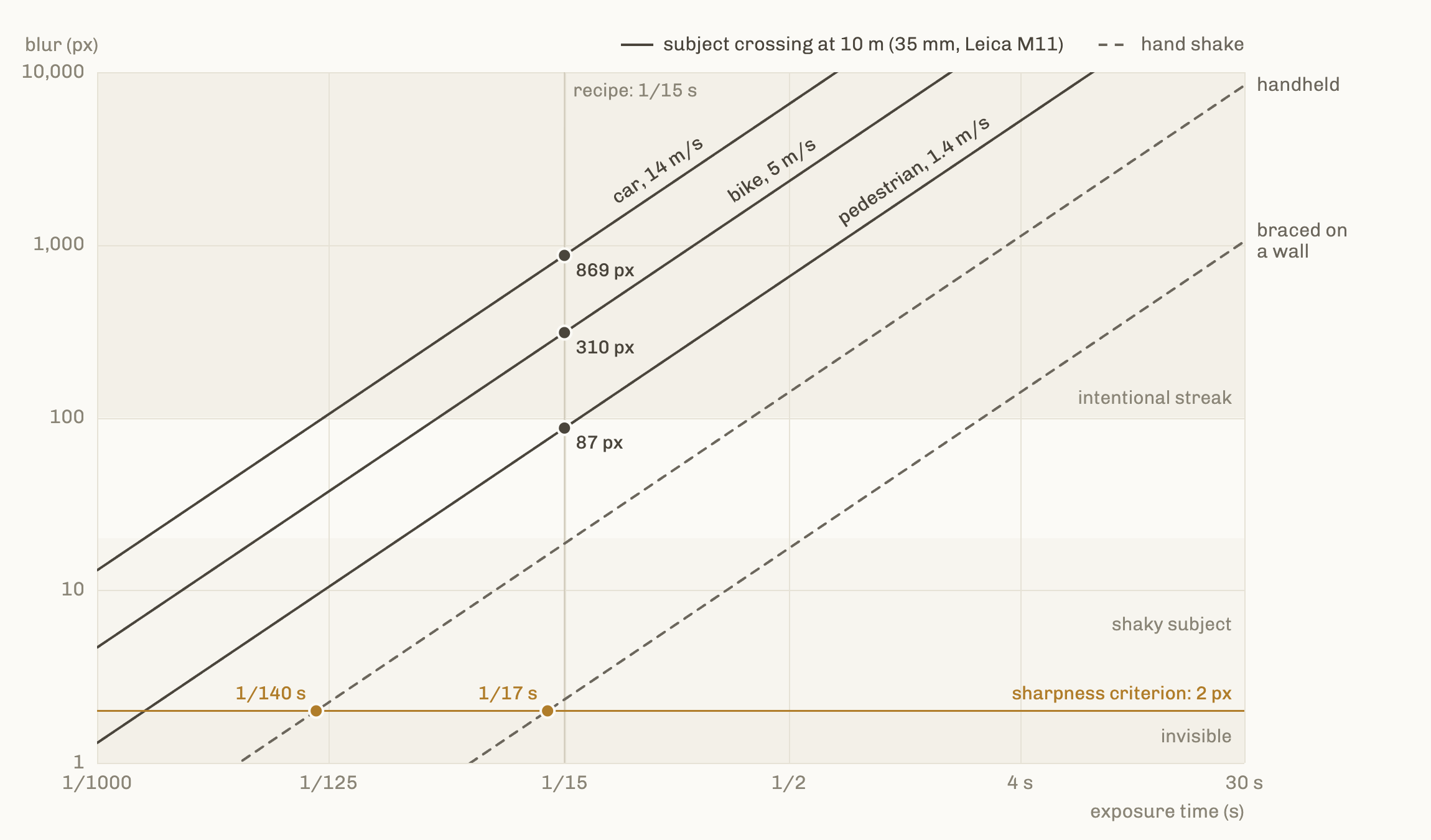
Long-exposure cheat sheets give you fixed times: 1/15 s for a pan, a quarter of a second for car light trails, thirty seconds to empty a square. As a starting point they’re fine, which is why they get passed around so much, but they break down as soon as the subject changes. With a 35 mm lens at ten meters, that same 1/15 s leaves a streak of 87 pixels if a pedestrian walks past, 310 if it’s a bike and 869 if it’s a car. The same recipe gives you three photographs that look nothing alike.
That’s why I’d rather do the math the other way around. I start from the effect, decide how much blur I want in the picture and work out the shutter time from there, along with how many pixels the streak will measure, whether I can hold the camera steady enough and which filter I’ll need. I’ve built it into an interactive tool, linked again at the end. Here are the calculations behind it. There are only a few, and you can do them in your head.
One formula for nearly everything
Picture someone crossing the frame at speed v, at distance d from the camera. Seen from the lens, they sweep an angle of v/d radians every second. The lens turns that angle into millimeters on the sensor by multiplying it by the focal length, and if you divide by the size of a pixel you get the length of the streak:
b = f · v · t / (d · p)
b comes out in pixels. f is the focal length in millimeters, v the speed in meters per second, t the exposure time in seconds, d the distance in meters and p the pixel pitch in millimeters, which on a Leica M11 is 0.00376. It’s high-school physics, and everything else hangs from this one line.
Look at it for a moment and you’ll see that focal length and distance appear as a ratio. Doubling both leaves the blur unchanged, because it depends on how much of the frame the subject fills. And since time sits in the same product, stepping back a few meters or switching to a 28 mm does the same job as shortening the exposure. Out on the street, that’s often the easiest thing to change.
Pixel pitch needs a little care. On the sensor, in millimeters, the streak is the same length on any full-frame camera. In pixels it varies: the scene that leaves 110 pixels on the 60-megapixel M11 leaves 70 on a 24-megapixel SL3-S. For the effect it makes no difference, because the streak covers the same fraction of the frame. For sharpness it matters, as the section on camera shake will show.
How much is a lot
A pixel count on its own tells you little, so it helps to keep three marks in mind. Below two pixels, blur is invisible, and up to about twenty you get a blurry subject, the kind that looks like a mistake. From a hundred upwards the streak reads as intentional. Between twenty and a hundred lies an ambiguous zone best avoided.
The size of the subject in the frame matters too. A person 1.70 m tall, six meters away and shot with a 35 mm, is about 2,600 pixels tall on the M11, and 110 pixels of blur barely softens their outline. If the same person is far off and only 300 pixels tall, that blur swallows them whole.
Your hands draw streaks too
The camera isn’t still either. However careful you are, your hand trembles with a residual angular speed. In the tool I’ve set it at 0.03 radians per second, a typical value for someone who holds the camera well and breathes calmly. The blur it causes comes from the same formula, with that angular speed in place of v/d, and it affects the whole image equally.
I’ve set the bar high: two pixels, which is one line pair at the sensor’s Nyquist frequency. With a 35 mm on the M11 that gives 1/140 s handheld, a long way from the 1/35 s suggested by the classic one-over-focal-length rule. That rule was born with film and modest print sizes, and sixty megapixels record shake that used to stay hidden. If the photo is going to end up on a screen or as a small print, you can be more lenient: a four-pixel criterion doubles the time, and eight multiplies it by four.
What you can improve for free is the way you hold the camera. Each of these habits halves the shake and so doubles the time you can hold. These are the longest times with a 35 mm on the M11:
| How you hold the camera | Longest time |
|---|---|
| Handheld, arms loose | 1/140 s |
| Elbows tucked in | 1/70 s |
| Strap pulled tight against your neck | 1/35 s |
| Braced on a wall or railing | 1/17 s |
The strap is the least known trick and the one that gives most for what it costs. Push the camera forward until the strap is taut around your neck and shoot with your arms out. The camera is now held between your two hands and the back of your neck, and that buys you two stops without carrying anything.
Stabilization comes on top and multiplies all of the above. The SL3-S stabilizes the sensor (Leica claims five stops) and the Q3 43 does it in the lens. Manufacturer figures are measured in favorable conditions and at short focal lengths, so on the street it’s wise to count on one or two stops fewer. Counting only four effective stops, an SL3-S braced on a wall goes from 1/11 s to almost a second and a half with a 35 mm. Bear in mind that stabilization corrects your movement and leaves the subject’s untouched, so it’s no help at all for freezing someone.
There’s one last trick that doesn’t depend on how you hold the camera either, and that’s shooting in bursts. Shake is random, and in a run of eight frames there’s usually one where your hand was almost still. If each single frame has a one-in-three chance of coming out sharp, with eight attempts the chance that at least one makes it is over 96%. Note that this works for camera shake. For subject blur it’s useless, because every frame in the burst is a different photograph.
Seven ways to ask for blur
The six starting techniques come from Pit Haupert’s Long Exposure Cheat Sheet (2025). Most of them are solved with the formula as it stands: they ask for a streak length and you solve for time. Light trails, for example, want a continuous streak of about 500 pixels, while a still person with the city moving around them makes do with about 220. Two of them follow a different logic, and I’ve added a seventh that the cheat sheet leaves out.
Panning
When you pan you move the camera on purpose, so your shake takes a back seat. The result depends on how well you follow the subject. I work with a tracking error of 15% of the movement: the background gets the whole streak and the subject only that fraction. With 110 pixels of background blur, the subject comes out with about 17 and looks clean. Once it goes past twenty pixels, the pan has failed.
That also explains why panning with a telephoto is so hard. The error percentage stays the same, but the total movement grows with focal length, so that 15% turns into many more pixels on the subject.
Ghost town
With this technique, everything depends on the exposure time. For a person to vanish, their light has to be spread so thin that it doesn’t stand out against the background. Each point in the frame is covered by them only for as long as they take to cross their own width, w/v, and for the rest of the exposure that point sees whatever is behind. With an exposure t, the person’s contrast over that point is divided by t·v/w.
At forty times that crossing time, the trace drops by a little over five stops and disappears:
t = 40 · w / v
With an apparent width of half a meter and someone strolling at 1.4 m/s, that comes to about fourteen seconds. Neither focal length nor distance appears in the calculation, which is why the thirty-second recipe works in any square. The spare margin covers whoever stops in front of a shop window, usually the person who ruins the picture.
The seventh: the subject leaves a trace
This is the in-between case. You aim, stay still, and the people walking past leave a trail you can still recognize. It looks like light trails but behaves differently. A headlight is so much brighter than the scene that its trail shows however long it gets. A person only reflects light, and as they move they spread it along their path. If the trace is k times their own width, no point in the middle is covered for more than a fraction 1/k of the exposure, and the silhouette keeps at most 1/k of its brightness.
With a trace one and a half times the subject’s width, the center keeps two thirds of its brightness. You can see the movement and the edges melt, but you can still tell who it is. For someone walking at 1.4 m/s that’s the time it takes to cover 75 centimeters, about half a second, with any focal length and at any distance.
Flash and zoom
That leaves flash freeze and zoom burst. For the first, the tool only works out the ambient light; the split between ambient and flash is handled by the flash bench, another page in the lab. Zoom burst doesn’t depend on subject speed either, because the streak is radial and its length depends on how far you turn the zoom ring. The figure there is only a guide, and a tripod is compulsory.
Light comes in at the end
So far there’s been no need to talk about light. It only appears at the end, to tell you whether you can reach the time the effect asks for. At ISO 100 the correct time is t = N²/2EV, where N is the f-number and EV the light in the scene. If the effect asks for more, the difference in stops has to be absorbed by a neutral density filter:
stops = log₂ (effect t / correct t)
An example with the ghost town. On an overcast day, at EV 13 and f/11, the correct time is 1/68 s. Reaching 14 s takes almost ten stops, exactly what an ND1000 gives. When the ISO you’d need without a filter falls below 25, the filter stops being optional, because no camera goes that low.
There are two costs the calculation leaves out. A strong ND is rarely fully neutral, and infrared leakage tends to tint the image. And beyond thirty seconds you run off the camera’s scale: it’s time for bulb mode, a remote release and keeping an eye on sensor heat.
What the formula doesn’t know
The formula assumes the subject crosses the frame side to side. If it comes toward you, the blur is much smaller and you have to multiply by the sine of the angle between its path and the lens axis. A car approaching diagonally, at 45°, leaves seven tenths of the calculated blur.
Shake isn’t a fixed number either. 0.03 rad/s is a typical value for a trained hand. In the cold, in a hurry or late in the day it gets worse; braced and holding your breath, it gets better. The longest time you get is a median: half the time you’ll do a bit worse, and that’s what bursts are for.
Diffraction and noise are also left out, and they’re what decide aperture and ISO. Stopping down to f/16 to stretch the exposure costs you detail, and that’s best measured separately.
The tool
All of this is built into an interactive page. You choose the technique, the body (M11, Q3 43 or SL3-S), focal length, distance, subject speed, support and light, and it gives you back the time, the length of the streak in pixels, whether you can hold it and which filter you need. It also draws the frame with the subject’s silhouette at its real size on the sensor, smeared the way the sensor integrates it, so you can watch a person fade as the exposure gets longer. It stores nothing, works offline and has an EN switch at the top.
If you’d like to go out and practice, the long-exposure walk sheet (in Spanish) has exercises for a day on the street and six photographers who worked with long exposures, from Daguerre to Michael Wesely.
The six techniques and the holding tricks come from Pit Haupert’s Long Exposure Cheat Sheet (2025). The calculations, the per-body figures and the chart are mine.


Deja una respuesta