Leer en español: Marco para pensar la fotografía
Turning it over, and reading, and reading…
This text is a personal synthesis, arranged as a framework for thinking, of a tour through some of the authors who have most helped me understand what I do when I photograph: Vilém Flusser, Roland Barthes, John Berger, Susan Sontag, Stephen Shore, Luigi Ghirri, Charlotte Cotton, Jun’ichirō Tanizaki, and the Japanese aesthetic tradition, which has thought about seeing and transience with a precision Western languages rarely reach. It does not claim to be exhaustive or neutral. It is the map that works for me, after a lot of reading and a lot of doubting, so as not to get lost when I raise the camera.
Starting point: the problem of the image already made
Every serious photographer sooner or later faces an uncomfortable suspicion: it seems that every photograph has already been taken. Visual archetypes have been exhausted for decades. The backlit portrait, the wet street at night, the long shadow at sunset, the reflection in the puddle. If photography is reduced to its iconography, the question is hard to answer.
But that reduction is the mistake. What is exhausted are the categories of image; the instances, on the other hand, never run out. The light coming into a room today, with this dust floating in it, with this exact color temperature, with this particular cutout on a surface that has aged in a certain way, has never been photographed, because it is an event rather than a category. What Roland Barthes called the punctum (the detail that pricks, bound to an irreducible contingency) cannot be exhausted, because it depends on the singular encounter between a gaze and an instant.
So, faced with a photo that may already have been made, the useful question is why I am making it, now. If that has an answer, it stops mattering whether someone made it before.
The apparatus and its program: Flusser
In Towards a Philosophy of Photography, Vilém Flusser proposes an idea that changes the very question of what taking a photo is. The camera is an apparatus that contains a program, and that is why it is never a neutral tool. When you shoot, you produce an image that the apparatus allows you to produce, which is something different from an image of the world. Before you even arrive, the camera already contains every photograph that can be made with it. Your job, whether you know it or not, is to select within that set.
Flusser distinguishes between redundant images (those that repeat an already explored possibility of the program) and informative images (those that wrest something improbable from the apparatus). And he calls the photographer who operates the apparatus without being aware of operating it a functionary: someone who believes they master it when in fact they are executing its default possibilities.
The principle that follows is to play against the apparatus, lucidly and without antagonism. That means knowing the program so you can betray it when it suits you, looking for improbable possibilities (which are not to be confused with impossible ones), and being suspicious of images that look too much like what you expected to get.
For an honest practice, the useful Flusserian question, before each exposure or when reviewing the archive, is: is this image executing a program, or fighting against one? And if it is executing one, whose program is it? The camera’s? Instagram’s? That of the photographers you admire and have ended up imitating? That of yourself five years ago?
Looking is not seeing: Berger, Sontag, Barthes
Seeing seems natural (we have eyes, we look), but scratch the surface a little and you discover that looking is one of the most cultural activities there is. John Berger showed that the gaze is historical: you look the way you were taught to look, and what you were taught depends on your era, your class, your visual culture. When you think you are looking, to a large extent you are remembering how to look.
Susan Sontag added a darker layer: photographing is always, to some degree, an act of appropriation. The camera, she says, is a sublimated form of the gun: both aim, shoot, capture. Worse still, photographing can be a way of not being there, of putting an apparatus between yourself and the experience so as not to have to live it fully. The camera then works as a shield.
But Sontag also recognizes that photography is one of the few ways in which we pay sustained attention to the world. Looking in order to photograph forces you to look in earnest. It is appropriation and attention at once, and there is no need to choose between them.
In Camera Lucida, Barthes introduces something neither Berger nor Sontag addresses: the gaze as an affective encounter. He distinguishes the studium (the culturally coded, what anyone can read) from the punctum (the detail that pricks, irreducible, tied to a contingency). The studium is indeed exhausted; the punctum, by definition, cannot be. And it happens in the viewer: the photo contains the possibility, and it is the viewer who actualizes it.
Two practical consequences follow. First, a gaze of your own operates in awareness of cultural heritage, without opposing it. An innocent eye is a romantic fantasy; what you can have is an eye that knows where it is looking from. Second, the viewer (including yourself ten years from now) is a constitutive part of the image. When you photograph for yourself, you still have an audience; you have just chosen one different from the statistical audience of the scroll.
The time of photography
At least three different temporalities coexist in every photograph. The time of the referent, when the scene was happening in front of the camera. The time of the exposure, the interval during which the shutter was open, which determines what shape what was happening takes in the image. And the time of viewing, the time you devote to the image, now, completely independent of the other two.
People often say the camera stops time, but what it does is turn time into something else. Photography is a particular form of time: compressed and flat. And it says, with absolute certainty, “this has been”, which also silently implies “this is no longer”. Photography has a structural affinity with transience, although it is almost never treated that way. Ordinary use tries to set the photo against time, as preservation. But the photo, seen up close, merely records that something passed, in both senses of the verb: happening and ceasing to be.
There is also a time that is rarely talked about and that matters a great deal: that of going back to your own photos years later. A photograph changes over time even though it is the same image. It changes because you change, because the context changes, because what once seemed important becomes secondary. There are photos you discarded five years ago that today you would recognize as the best of that period. It may look like a failure of judgment, but it is a property of the medium: photography matures.
A Japanese constellation to organize practice
For centuries, Japanese aesthetics has thought about seeing and transience. Four of its concepts together form a precise framework for a photographic practice oriented toward the subtle. Each one answers a different question.
Wabi-sabi is a quality of the world: the beauty of the incomplete, the worn, what time has touched. It lies in things themselves, regardless of who is looking. It directs attention toward what is normally ignored: middle textures, muted colors, modest surfaces. It is a way of recognizing that everything is aging, even the new, and that this action of time is beautiful; reducing it to a decorative style or a repertoire of old objects misreads it. It answers the question of what to look at.
Mono no aware is a response of the subject: the melancholy awareness of transience, the emotion before the fragility of what exists, knowing it will disappear. The cherry tree in bloom is beautiful precisely because it lasts only a few days. Beauty is shot through with loss. Photography has a structural affinity with this emotion, because every exposure certifies a presence and, at the same time, its loss. It answers the question of what you feel before what catches your eye.
Ichigo ichie is a temporal disposition: the awareness that every encounter is unique and unrepeatable, and the corresponding attention. Applied to photography, it contrasts with Cartier-Bresson’s doctrine of the decisive moment. The decisive moment is centripetal: the photographer concentrates attention on an imminent future point, anticipates, waits for the moment when the elements align. It is a hunter’s posture. Ichigo ichie is centrifugal: attention opens to the present instant without projecting toward a climax. You stay with what is already going on, without waiting for something to happen. Here the posture is that of a host. It answers the question of how to be present.
Yūgen is a quality of the image as an object: the capacity to evoke more than it shows, to point toward what is not there. It operates in the resulting image, once the encounter is over. The distinction matters because you can live an encounter full of the three previous concepts and produce a photo without yūgen. You were present, you recognized the quality of things, you felt the transience, and the photo comes out flat. Yūgen is a quality the image has to earn as a representation. It answers the question of what the resulting image has, if you achieve it.
The practical consequence of this distinction is that the work does not end with the click. It continues in editing, in processing, in selection, where it is decided whether what the encounter had will survive or be lost through excess or deficiency.
Crutches, and why they destroy what matters
Some images do not contain much. There is no encounter, no light worth having, no texture that says anything. They are photos of the pure Flusserian program: the apparatus recorded something because someone pressed the button, and nothing more. Seen raw, they give away their own emptiness.
That is where the crutch shows up. High-contrast black and white, dramatic blur, warm toning, added grain, vignetting, cinematic-look presets: post-production operations that add to the image an intensity it did not have. The result is a photo that looks intense, but all that intensity comes from how it was processed. The weight has shifted from the moment of the exposure to the moment of editing.
The crutch works because it triggers automatic cultural associations: high-contrast black and white summons documentary seriousness, selective blur says “look here, this matters”, toning evokes cinematic codes. A banal photo processed with crutches acquires a borrowed authority. And it fools the photographer above all, which is the most insidious part. When dramatic processing “saves” a flat photo, you get a reward that acts as reinforcement: next time you shoot with less rigor, because you know you can save anything in post-production.
The difference between a crutch and a language is internal. In processing as language (Daido Moriyama, Trent Parke, certain color decisions by Saul Leiter) the image and its treatment need each other; one means through the other. In processing as a crutch, the treatment replaces the image, does its job, covers it up. There is a test to tell them apart: if your processing works equally for all your photos, if any photo improves once the preset is applied, it is a crutch. If it responds to what each photo needs and sometimes consists of leaving it almost unprocessed, it is language.
The test also works the other way around: look at the photo as an almost neutral raw. If it still says something, later processing will be fine-tuning. If the raw photo is a corpse that only comes alive with processing, there was no photo.
The photographic language: Shore
In The Nature of Photographs, Stephen Shore proposes that every photograph exists simultaneously on three levels. The physical level: the photo is a material object, with size, support, texture. A well-made paper print and the same image on a screen are different experiences. The depictive level: the photo describes a world through four basic means. The mental level: the photo is something that happens in the viewer’s mind, which reconstructs, associates, completes, anticipates.
The four means of the depictive level are the constitutive dimensions of photographic language, the things the camera inevitably does to the world, whether you like it or not. The photographer’s job is to decide consciously what the apparatus does anyway.
Flatness: the camera takes a three-dimensional world and translates it onto a flat surface. In that translation, the relationships between elements change from how you perceive them in reality. Things that were meters apart can touch, align or merge in the photo. Photographing is, to a large extent, seeing how the scene will flatten before it flattens.
Frame: framing looks like a matter of choosing what goes into the photo, but what it involves is deciding where the boundary lies between what is in and what is not. The frame constitutes the image. There is active framing, where the photographer looks for the specific boundary that organizes the image, and descriptive framing, where the camera is allowed to account for a piece of the world without intervening much at its edges. Both are legitimate, but knowing which one you are using, in each exposure, matters.
Time: exposure duration, besides being a technical parameter, is a decision about what kind of time the image will hold. A short exposure freezes; a long one accumulates; a medium one approaches human perception. The same scene at 1/1000 and at thirty seconds gives you two different worlds.
Focus: where the image demands sharpness and where it allows blur. This creates a visual hierarchy: what is sharp asks for attention, what is blurred gives it up. But that hierarchy is chosen, and nothing forces you to impose it. A photo with wide depth of field gives viewers the possibility of looking freely, of discovering relationships the photographer did not impose, and in that sense it is a more generous image.
Two common confusions
When the criteria get mixed up, two symmetrical confusions appear that ruin many images.
Confusion A: asking a descriptive photo for a compositional intensity it does not have. You photograph an atmosphere, a light, a texture, with no geometry to close. On review, the photo seems weak. You start cropping it, raising contrast, looking for strength. What was a description of a moment of light becomes a failed attempt at a striking image. The right move would have been to accept its descriptive quality and let the atmosphere breathe. If it did not hold up without tricks, the photo had nothing more to give.
Confusion B: asking a compositional photo for the openness of a description. You photograph a moment where there was a geometry to close, a visual rhyme to use. On review, it seems “too easy”, “too textbook”. You choose a less resolved version so it looks more casual. But the photo was the first one, and there was nothing wrong with it. What bothered you was the discomfort of admitting that sometimes the world hands you compositions, and accepting them, even if it feels like taking the easy way out, is recognizing what was there.
Put simply, the rule is to honor each photo in its own mode. Do not ask a description for the force of a composition, or a composition for the breathing room of a description.
Color as the description of a moment of light
There are three very different ways of thinking about color in photography. Color as code (red means danger, blue means cold) is the logic of advertising and semantic manipulation. Color as formal composition (Saul Leiter as the highest example) treats color as a plastic element that relates to other colors on the surface. Color as the description of a moment of light (Stephen Shore, Luigi Ghirri, much contemplative photography) understands color as the exact trace of how light touched things at that moment.
For a practice oriented toward transience, the last two are the relevant ones, especially the third. The light at four in the afternoon on a Saturday in October has a color like no other, and photographing that color is photographing that moment. Converting it to black and white throws away half the information of the encounter.
In this logic, color processing should almost always be much lighter than preset culture asks for. Raising global saturation makes every color shout, and the original chromatic hierarchy (which was part of the image) disappears. Toning destroys the information of the moment: the light that was actually there stops being the light of the photo. The useful rule is to start from neutral and add the minimum necessary, instead of starting from the preset and subtracting.
Luigi Ghirri is probably the most useful reference for a sensibility oriented this way. His palettes are colored grays, beiges, muted ochres, very washed-out blues. They are colors he seeks out, and they owe nothing to processing: Ghirri is where those colors are. His framings leave space, his tones sit in the middle range, and he never underlines anything. What you can learn most from him is his confidence that the image does not need to shout to have something. His surface style matters less: it is easy to imitate and hard to make your own.
The archive as an organism
Editing and the archive are probably where a photographer is made, much more than in the shooting or in theory. And it is worth distinguishing three operations that are often confused: processing (what is done with each individual file), selection (which photos survive and which are discarded) and sequence (in what order the selected images are presented).
Selection is the hardest discipline. It has less to do with refined taste than with sustained honesty toward your own work. There are two opposite mistakes. Selecting too early, in the heat of the moment, when you are still emotionally involved with what you lived and cannot see what the image contains. And never selecting, leaving everything in the archive: “I’ll choose later”.
There are two biases worth recognizing because they ruin selection. The memory bias: you keep a photo because it reminds you of the moment, even though the image alone does not convey it. The test is to ask: if someone else had taken this photo, without your memory of the encounter, would you still keep it? The prestige bias: you keep a photo because it looks like a good photo, because you recognize in it echoes of a photographer you admire. And the reverse: you discard images that do not resemble anything you recognize, and precisely for that reason they could be the most interesting ones, the closest to a gaze of your own.
An archive is an organism that grows and matures. Treat it as a warehouse and it fossilizes. Treat it as an organism and a photo from five years ago starts talking to one from last month, and in that dialogue you discover that for five years you have been photographing, without knowing it, the same thing. Series that were never planned are recognized in the archive: they are yours, they had been forming for a long time, and only now do you identify them.
That is why it is worth returning to the archive regularly and with no instrumental purpose, simply to look at it, without hunting for a photo for some specific use. That visit is where the archive teaches you what kind of photographer you are, what you look for, what you find. And where, almost without your noticing, a gaze of your own appears: the one you actually operate. It is almost always different from the idea you had of it.
The whole framework, condensed
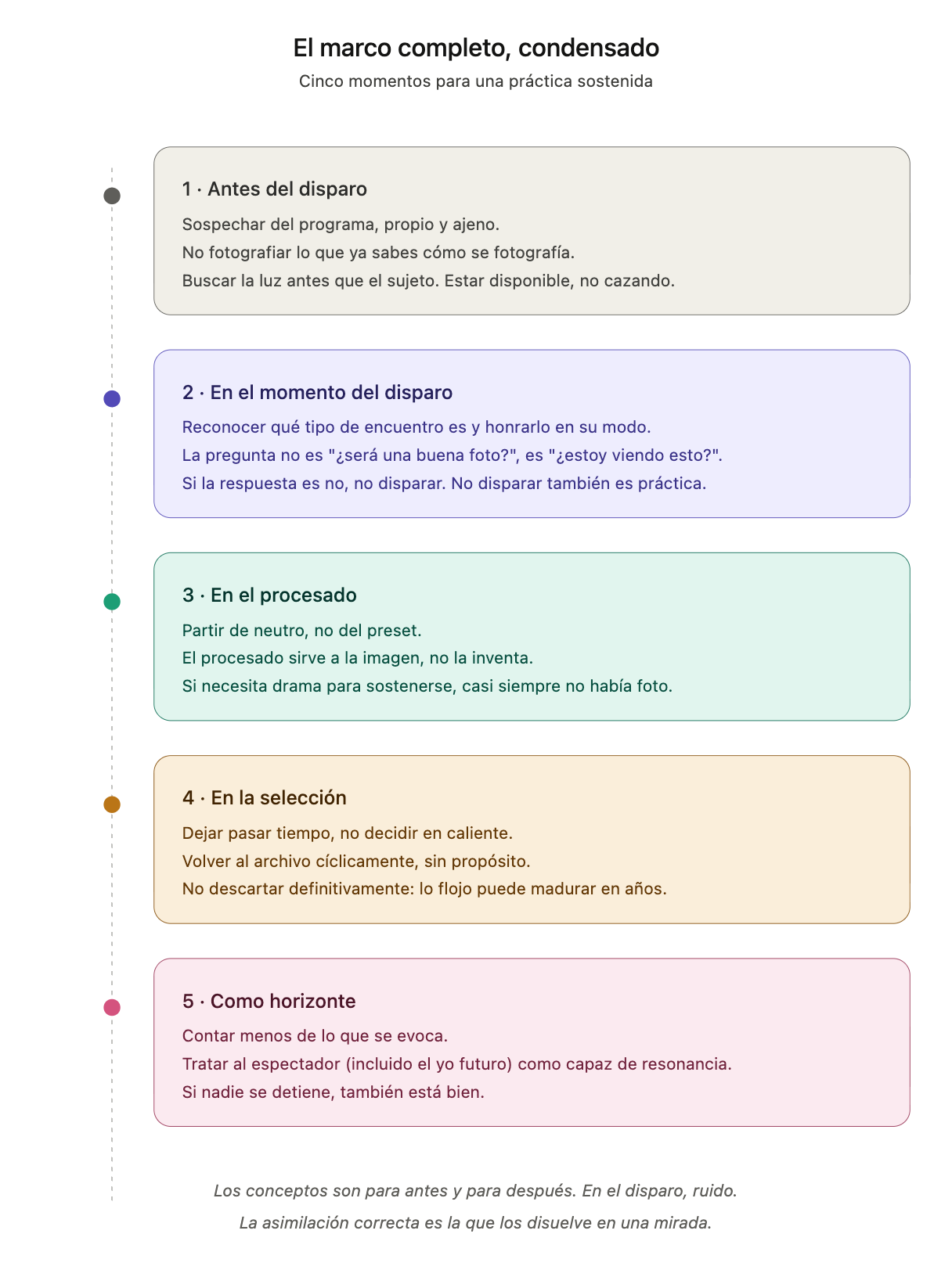
If I had to reduce everything to a compact framework to keep in my head, I would say something like this.
Before the exposure: be suspicious of the program, your own and other people’s. Do not photograph what you already know how to photograph. Look for the light before the subject. Be available and do not go out hunting.
At the moment of the exposure: recognize what kind of encounter it is (atmosphere or composition, description or instant) and honor it in its own mode. Replace the question “will this be a good photo?” with “am I actually seeing this?”. If the answer is no, do not shoot. Outings where nothing is shot are as useful as those that produce images.
In processing: start from neutral, with no preset. Processing serves an image that already exists, and if a photo needs dramatic processing to hold up, there was almost always no photo. Resist the reflex to underline, add contrast, tone.
In selection: let time pass and do not decide in the heat of the moment. Return to the archive cyclically, with no purpose. Do not discard definitively: what looks weak today may prove precise in five years.
As a horizon: tell less than you evoke. Treat the viewer (including your future self) as capable of resonance. Trust that if the encounter was real and the image respects it, someone who stops will see it. And if nobody stops, that is fine too.
The concepts are for before you shoot (guiding practice) and for after (analyzing the archive). At the moment of the encounter they are noise. The right assimilation of any framework like this one is the one that dissolves it into a way of seeing that no longer needs to name it. It works like that kind of knowledge you do not notice when you have it, and that only shows when it is missing.
This is an indicative bibliography, organized by the role each text plays in the framework I have been building. Without any claim to being exhaustive or neutral, it gathers the books and authors that have most helped me think about photography, grouped by the question they answer.
Philosophy and theory of the photographic image
Vilém Flusser. Towards a Philosophy of Photography. Original: Für eine Philosophie der Fotografie, 1983. The founding text for thinking of the camera as an apparatus and the photographer as a functionary who executes a program, or fights it. Short, dense, uncomfortable.
Roland Barthes. Camera Lucida: Reflections on Photography. Original: La chambre claire, 1980. The distinction between studium and punctum, and the formulation of photography as a certificate of existence (the “this has been”). Essential.
Susan Sontag. On Photography, 1977. The camera as appropriation, photography as attention and as a shield. Debatable on many points, but formidable as a sustained provocation.
John Berger. Ways of Seeing, 1972. Not strictly about photography, but its thesis of seeing as a historical construction is decisive. Short and luminous.
John Berger. The essays collected in Understanding a Photograph (2013), a selection of his writings on photography scattered across his work. Berger thinking about the image is always less systematic and more penetrating than most formal theorists.
The practice of photographic language
Stephen Shore. The Nature of Photographs, Phaidon, 1998 (with later editions). The three levels (physical, depictive, mental) and the four means of the depictive level (flatness, frame, time, focus). You read it in an afternoon and keep returning to it for years.
Luigi Ghirri. Lezioni di fotografia. Quodlibet, 2010 (with reprints). If you read Italian, it is a must-read. If not, there is an English translation of his shorter writings, The Complete Essays 1973–1991 (Mack, 2016), which is different from the book of lessons.
Joan Fontcuberta. Pandora’s Camera: Photogr@phy after Photography (Mack, 2014; Spanish original 2010), and El beso de Judas. Fotografía y verdad (1997, in Spanish). An essential thinker for understanding the question of photographic truth and photography after the digital turn.
An overview of contemporary photography
Charlotte Cotton. The Photograph as Contemporary Art, Thames & Hudson, 2004 (revised editions in 2009, 2014 and 2020). The most useful map of the territory there is. The eight categories it proposes work as reading tools, without the rigidity of a taxonomy.
Liz Wells (ed.). Photography: A Critical Introduction. Routledge, several editions since 1997 (the sixth is from 2021). An exhaustive academic handbook, useful as a reference for the great critical debates (index and trace, documentary and representation, gender and the gaze, photography and art).
Geoff Dyer. The Ongoing Moment, 2005. A free-form essay, far from both the handbook and academic theory, that connects photographers through recurring motifs (hats, hands, stairs, the blind). A delightful way of thinking about photography without a system.
Japanese aesthetics applicable to photography
Jun’ichirō Tanizaki. In Praise of Shadows. Original: In’ei raisan, 1933. The defense of half-light, middle tones, the subtle materiality of objects in low light. Indispensable for understanding the sensibility opposed to Western brightness and sharpness.
Andrew Juniper. Wabi Sabi: The Japanese Art of Impermanence. Tuttle Publishing, 2003. A solid tour of wabi-sabi that avoids New Age clichés. Useful for understanding the difference between decorative style and aesthetic disposition.
Leonard Koren. Wabi-Sabi for Artists, Designers, Poets & Philosophers, 1994. The short book that made the concept circulate in the West. More accessible than Juniper, and also more simplifying.
Laurent Barrera. Japanese Aesthetics in Photography: Wabi-sabi, Mono no aware, Zen… A Different Way of Photographing. Self-published, second expanded edition 2026. It is introductory, written for photographers with no prior background in Japanese aesthetics, and it has the virtue of treating the concepts as working tools, without falling into exoticism.
Donald Keene. Placeres japoneses (a Spanish selection, 2007). For going deeper into mono no aware and yūgen through classical Japanese literature. More historical than applicable to photography, but useful so as not to settle for the simplified version of the concepts.
Other useful texts
Henri Cartier-Bresson. The Decisive Moment, 1952; there is a facsimile edition by Steidl (2014). And the interviews collected in Ver es un todo. Entrevistas y conversaciones 1951–1998 (Gustavo Gili, 2014). To understand first-hand the formulation of the decisive moment, and also its nuances, which the cliché has simplified.
Mariano de Santa Ana (ed.). Elogio de la mirada. I have seen this title attributed to several different compilations, so it is worth checking the specific edition. The general idea of the title gathers a tradition of short essays on seeing that converses well with Berger.
On Otto Steinert and Subjective Photography, the material in Spanish is scarce. The most useful reference is Oscar Colorado’s entry on his site Oscar en Fotos (oscarenfotos.com), which has a long article on the movement. For the original texts you have to go to the German publications of the 1950s (the three editions of Subjektive Fotografie, 1952, 1955 and 1958).
Photographers whose complete work is worth knowing
Apart from the theoretical texts, a photographic education comes above all from looking at the complete work of certain photographers. For the sensibility I have been describing, the most relevant would be:
- Luigi Ghirri: Kodachrome (1978, reissued by Mack), Il profilo delle nuvole (1989), Paesaggio italiano (1989).
- Stephen Shore: Uncommon Places (Aperture, expanded edition 2014) and American Surfaces (Phaidon).
- William Eggleston: William Eggleston’s Guide (MoMA, facsimile of the 1976 edition) and The Democratic Forest (Steidl).
- Saul Leiter: Early Color (Steidl) and In My Room (Steidl).
- Rinko Kawauchi: Utatane, Illuminance, Halo (various publishers, mainly Aperture and Chose Commune).
- Masao Yamamoto: Tori, Small Things in Silence (Radius Books).
- Bernard Plossu: Le Voyage Mexicain and others (various French publishers).
- Wolfgang Tillmans: any of his monographs is useful for understanding the category Something and Nothing.
A final note on how to use this list. The amount of literature available on photography is overwhelming, and reading a lot does not guarantee seeing better. If I had to reduce it to the essentials, I would say: Barthes, Shore, Sontag, Cotton and Tanizaki.


Deja una respuesta