Leer en español: La foto rota: cinco conceptos para aprender a mirar
The broken photo: five concepts for learning to see
Photography is about learning to see reality, without trying to perfect it.
Before we start: intention
Before going into the five main concepts, it helps to set a basic attitude: photograph what exists here and now with an unrepeatable intensity, whether or not it is photogenic.
Ichigo ichie
Ichigo ichie means, literally, “one encounter, one time”. In photography it proposes swapping the question “is this beautiful?” for another one: “does this exist now and only now?”. It is an attitude of presence, without nostalgia or melancholy.
Transit
Transit is about photographing what movement alters; the movement itself stays in the background. It looks for the consequence of passing through, once the action is no longer in sight: a used space, a trace, a suspension, a minimal transformation that lets you feel someone was there.
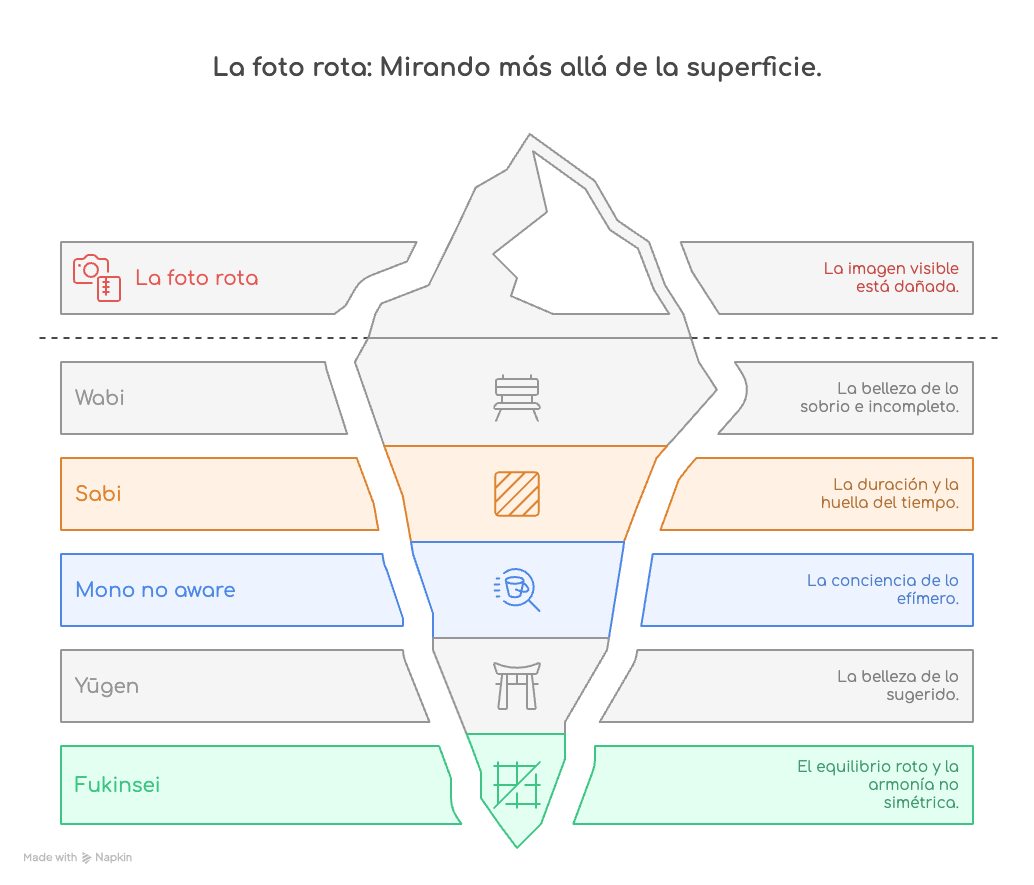
The five concepts
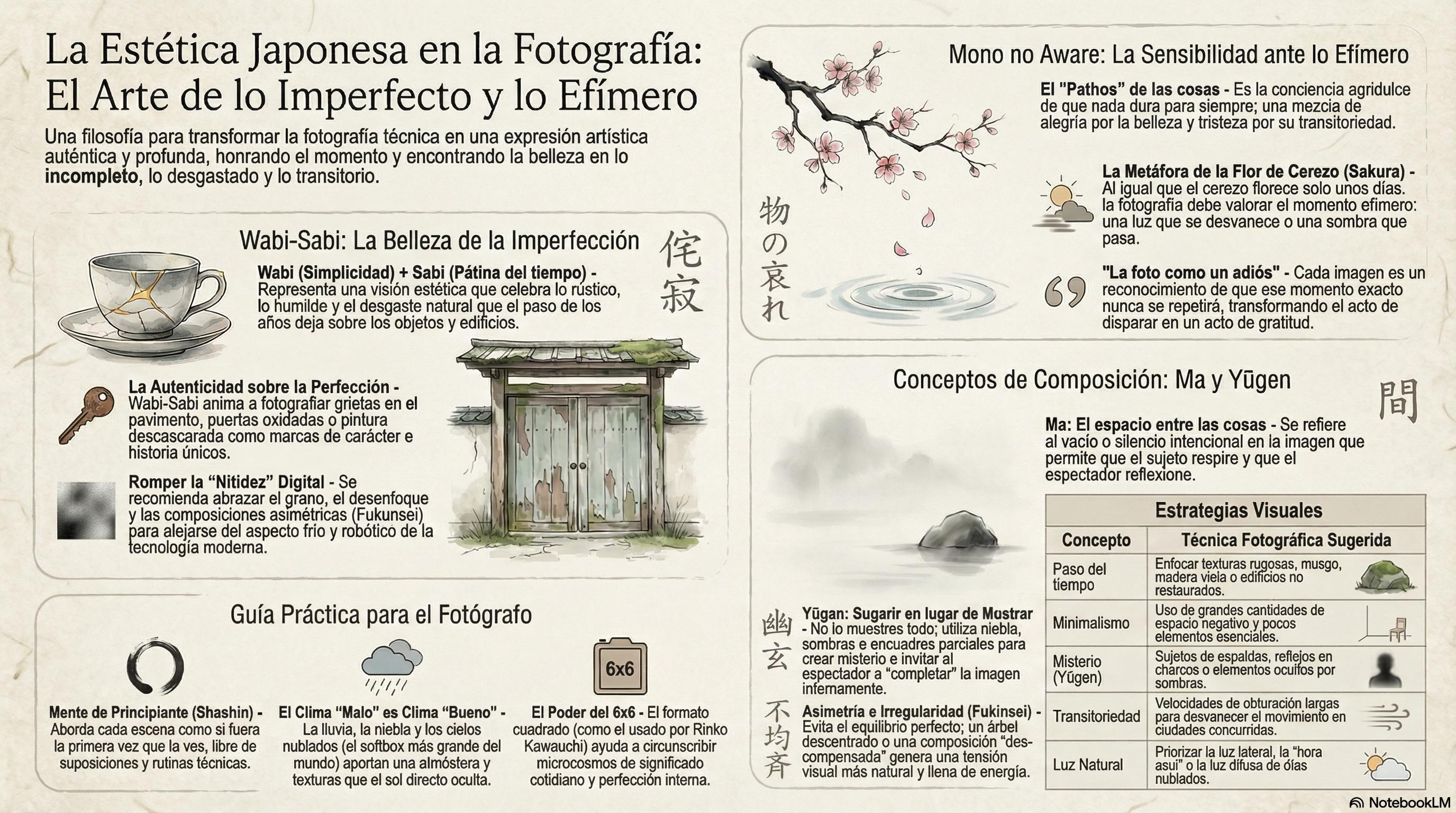
1. Wabi
Wabi is the beauty of the essential, the sober and the incomplete. It describes an attitude of austerity, stillness and intention toward the real, without referring to any specific object.
Austerity is the presence of the essential, even if at first glance it can look like something is missing. Wabi appears when an image stops seeking impact and begins to accept that it does not need “more” to hold truth.
It is the feeling of entering a small room, with little light and few objects, and feeling calm without quite knowing why. In photography, that translates into an eye capable of recognizing value where nothing apparent is happening.
It should not be confused with visual poverty, carelessness, dirt, or a technical error turned into an excuse. Nor does it have anything to do with empty minimalism or with a photo that is weak because there is no action.
Wabi works with three main dimensions: austerity, irregularity and stillness. Austerity means framing by subtraction, and irregularity means fleeing from overly designed perfection. Stillness is recognizing that a pause also has presence.
2. Sabi
Sabi is the beauty of the trace of time, of what has endured and shows a visible history on its surface. It is the dignity of what has been used.
It celebrates the present value of what time has touched and, therefore, signed, without making ruin an end in itself or old age a piece of emotional scenery.
Sabi is the evidence of a material history that is still here. It has nothing to do with nostalgia, with the easy comparison between old and new to build a quick metaphor, or with dramatized decay.
Photographing with a sabi eye means treating time as a creative material. You look for a surface that reveals duration, use, wear, permanence and visible memory, instead of a “pretty” object or a picturesque background.
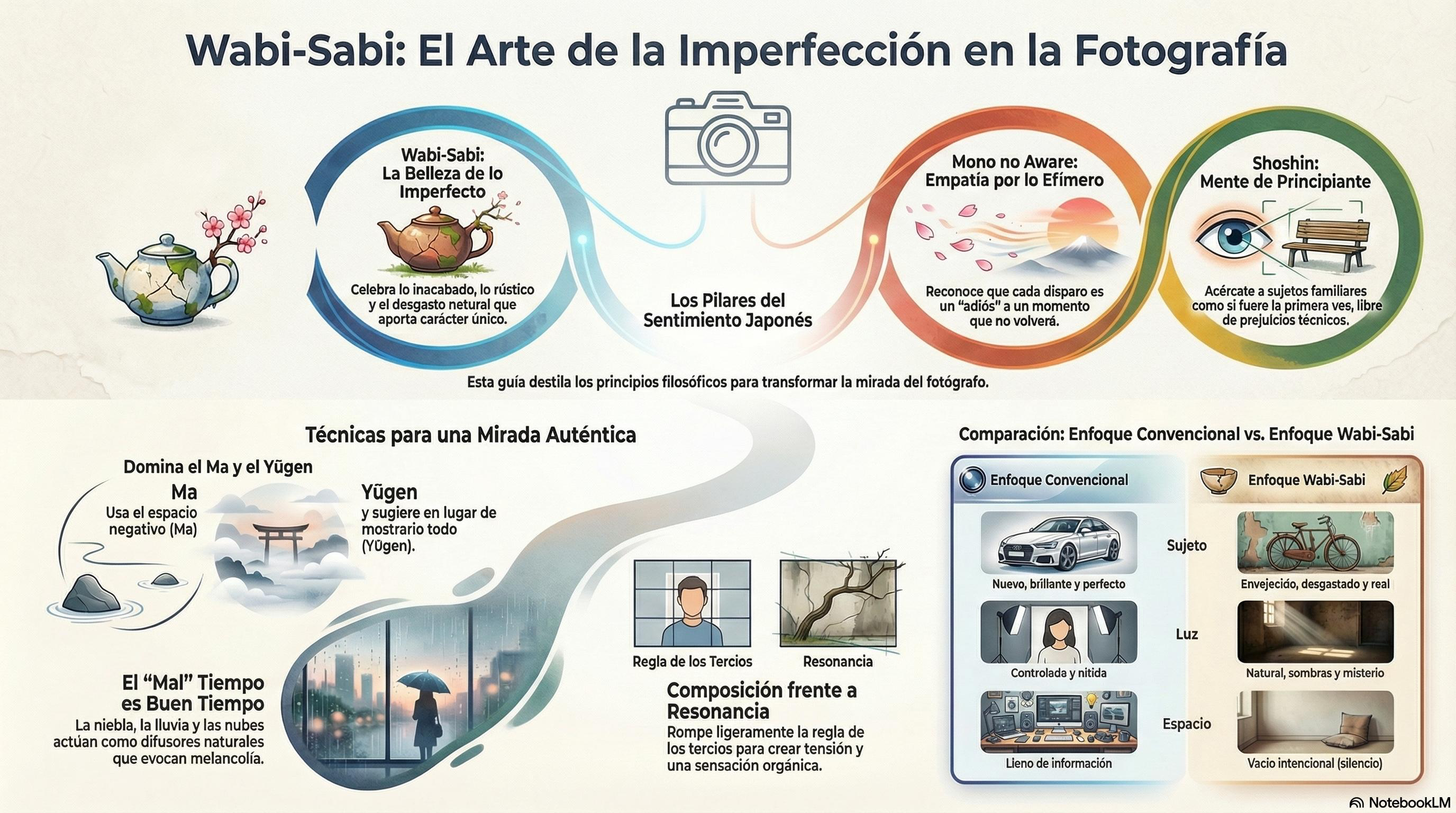
3. Mono no aware
Mono no aware is the emotion of knowing that something is here now and one day will not be. It shows up in grand scenes and obvious farewells, but above all in the banal.
Its strength lies in the awareness of the temporal, far from any theatrical sadness. The emotion comes from recognizing that the everyday also comes to an end, and nothing spectacular is needed for that.
There is an important difference between photographing something pretty and photographing something that contains time. In the first case you capture an appearance; in the second, a relationship between that object, that moment and the one looking at it.
Mono no aware turns ordinary life into a photographic subject. A cup, an afternoon light, a neighborhood shop, a mark on the wall or a pair of slippers in the hallway stop being background once they are understood as something that will one day have existed.
4. Yūgen
Yūgen is the beauty of the suggested, of what is sensed but not fully given. It works when the photograph leaves gaps and forces the viewer to complete the image from within.
Aesthetic darkness, empty mystery or bad cropping to look profound are something else. What separates a suggestive image from a merely incomplete one is intention.
When a photo shows everything, it answers too quickly; when it conceals with judgment, it asks, and the viewer’s emotional involvement begins with that question.
Yūgen appears in shadows, backs, partial reflections, thresholds, fog, smoke, off-frame presences and incomplete gestures. What it requires is choosing the exact point at which the image still breathes mystery without ceasing to be precise, which is a far subtler thing than hiding.
5. Fukinsei
Fukinsei is intentional imbalance, living tension and non-symmetric harmony. It is a composition that holds up without needing to be centered or perfectly closed.
Its value lies in irregularity with meaning, which sets it apart from chaos, from tilting the frame for the sake of it, or from denying every compositional rule.
An image with fukinsei gives up the rest of perfect symmetry and looks for a livelier visual energy. It works with unequal weights, lines that do not quite close, active empty spaces and tense relationships between elements.
It is the composition that keeps the frame breathing. If centering a subject drains the photo of life, there was probably fukinsei in the off-center version.
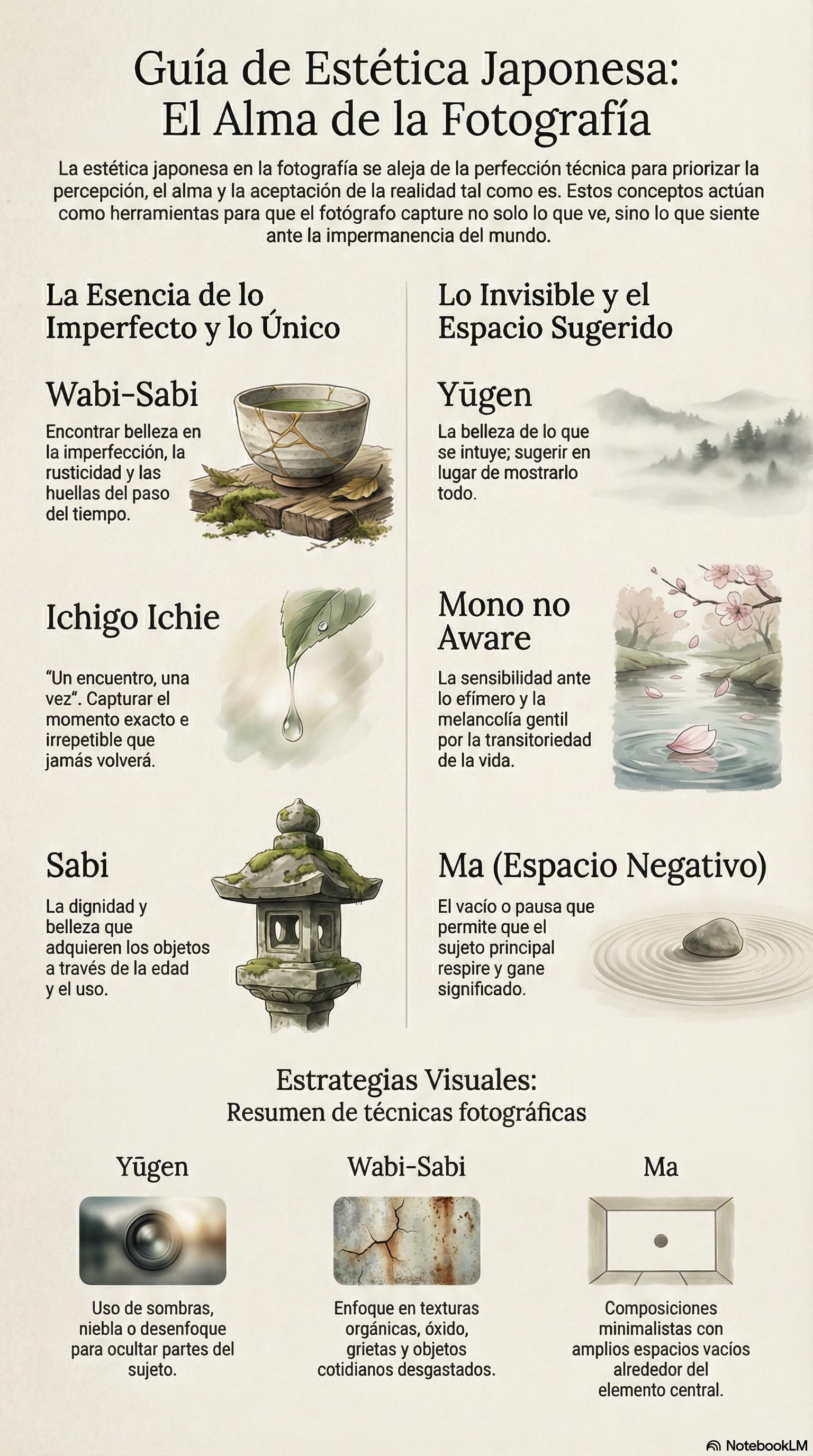
Comparison of the concepts
| Concept | What it celebrates | What to look at | What it is not | Essential phrase |
|---|---|---|---|---|
| Wabi | The essential, sober and incomplete | Empty spaces, still light, simple objects, margins | Visual poverty, carelessness, empty minimalism | “What is extra goes; what is missing is enough.” |
| Sabi | The trace of time and the dignity of the used | Worn surfaces, paint over paint, edges, steps, patina | Easy nostalgia, obvious contrast, dramatized decay | “What time has touched, time has signed.” |
| Mono no aware | The emotion before the temporal and what one day will be gone | The everyday banal, habits, corners, repeated lights, unheroic objects | Theatrical sadness, decorative sentimentality, only big moments | “Everything goes. Photograph that.” |
| Yūgen | The suggested, the incomplete, the sensed | Shadows, backs, partial reflections, thresholds, off-frame | Aesthetic darkness, arbitrary concealment, posturing mystery | “The photo does not answer. The photo asks.” |
| Fukinsei | Broken balance and living asymmetry | Unequal weights, active empty spaces, tensions, open lines | Chaos, unintentional tilting, gratuitous rupture | “If centering it kills it, do not center it.” |
Examples by setting
| Concept | Street | Travel | Home |
|---|---|---|---|
| Wabi | Empty bench, wet ground after the market, lowered shutter, doorway in soft light | Corner next to the cathedral, table marked by years, an ordinary nook of the place | Cracked cup, unfinished book, hallway in its usual light, empty sink |
| Sabi | Peeling walls, doors with layers of paint, rusty railings, worn steps | Eroded granite, locally aged wood, the material trace specific to the place | Inherited armchair, marked table, book with a broken spine, piano with signs of use |
| Mono no aware | The usual bar, a torn sign at the bus stop, the market at closing time, a regular bench | Afternoon light, breakfast on the last day, the sound of a street in the morning | Chipped cup, slippers in the hallway, half-finished coffee, mark on the wall |
| Yūgen | Shadow of two people, a hand on a handrail, partial reflection in a wet shop window | Window lit from outside, dark corridor, a local figure seen from behind | Empty chair, abandoned open book, cup with remains, door ajar |
| Fukinsei | Streetlight pushed into a corner, sign on an edge, a large void with a minimal element | Off-center horizon, side door, streetlight displaced in a square | Misaligned table, off-center window, lamp that breaks the symmetry |
How they relate to each other
Although each concept has its own logic, they do not work as closed compartments. In practice, they tend to mix.
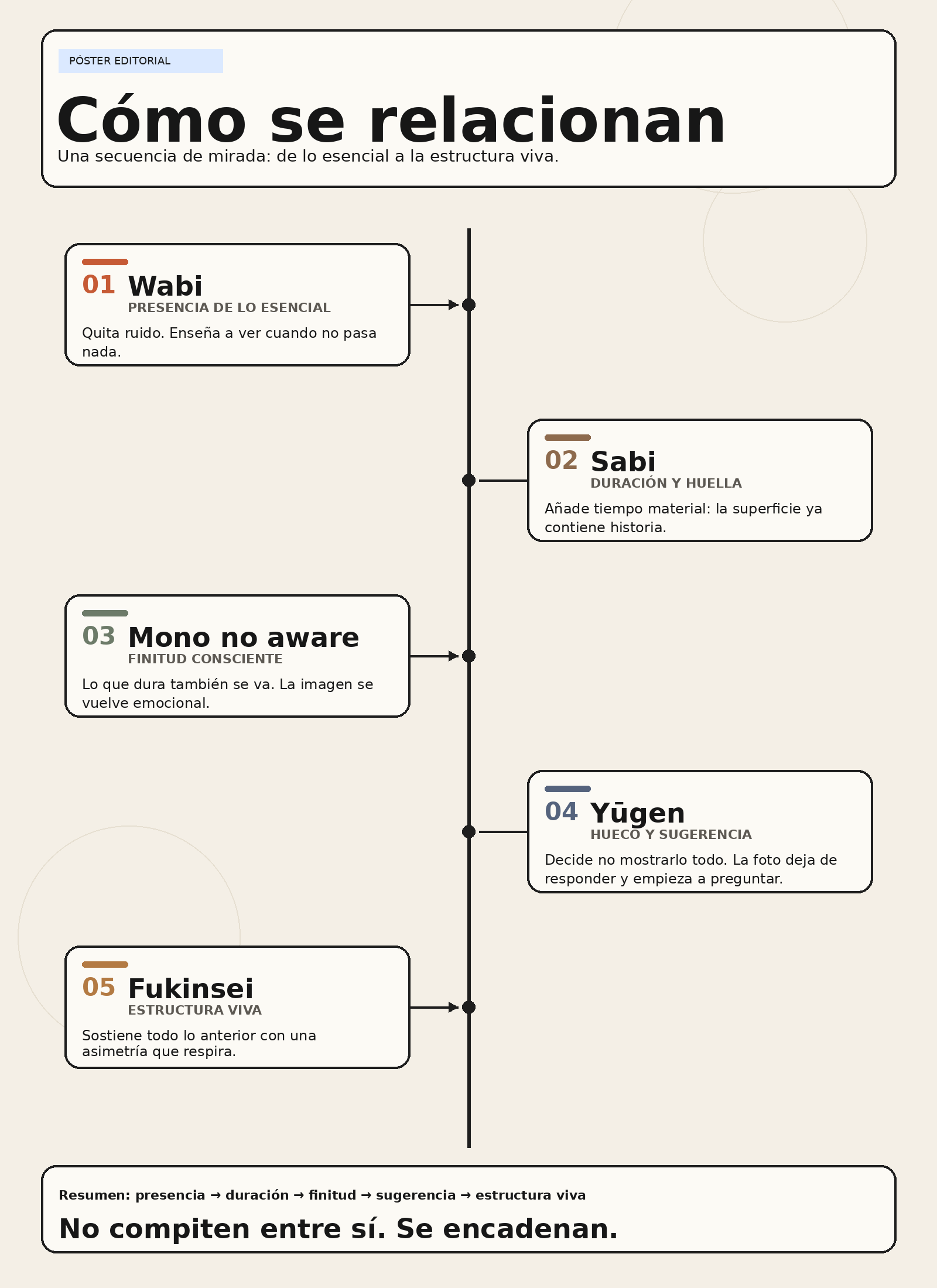
Wabi and Sabi form an important base: one deals with the essential and the incomplete; the other, with duration and the trace of time. Mono no aware adds the awareness that all of this is temporary, and Yūgen decides not to show everything. Fukinsei, for its part, holds the image formally so that this sensibility does not turn into mere disorder.
If each had to be reduced to a single verb: Wabi cleans, Sabi thickens, Mono no aware moves, Yūgen opens and Fukinsei organizes without rigidity.
What changes in the photographer’s eye
This way of working displaces several widespread habits: the chase for the perfect photo stops, the dependence on the spectacular decreases, and a more precise attention to the everyday, the lateral, the silent and whatever normally works as background begins to appear.
The relationship with time also changes. Instead of looking only for the decisive moment, you learn to look at accumulation, pause, duration, disappearance and consequence.
Finally, composition changes. The photo stops being organized only to demonstrate control and begins to be organized to sustain presence, tension, suggestion and truth.
Examples
Wabi: Masao Yamamoto
For Wabi, what works best for me is a minimal, fragile, almost silent reference, in which the image seems to hold itself up with very little. I would use it as an example of austerity, intimacy and non-emphatic beauty.
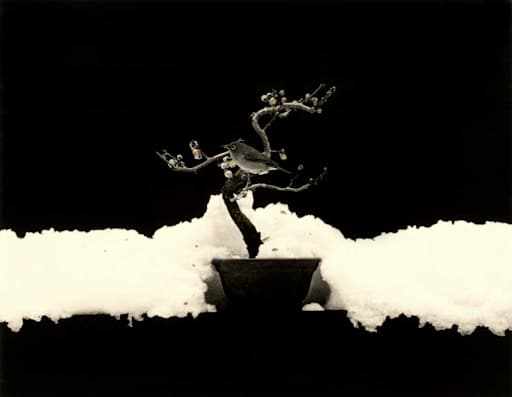
What matters here is the breathing of the subject, its delicacy and a very restrained presence, and “the spectacular” stays on the sidelines.
Sabi: Shomei Tomatsu, The River Styx, Aomori
For Sabi, this image fits because of its sense of trace, wear and accumulated time rather than any specific anecdote. It works for me as an example of a surface that seems to have lived before being photographed.
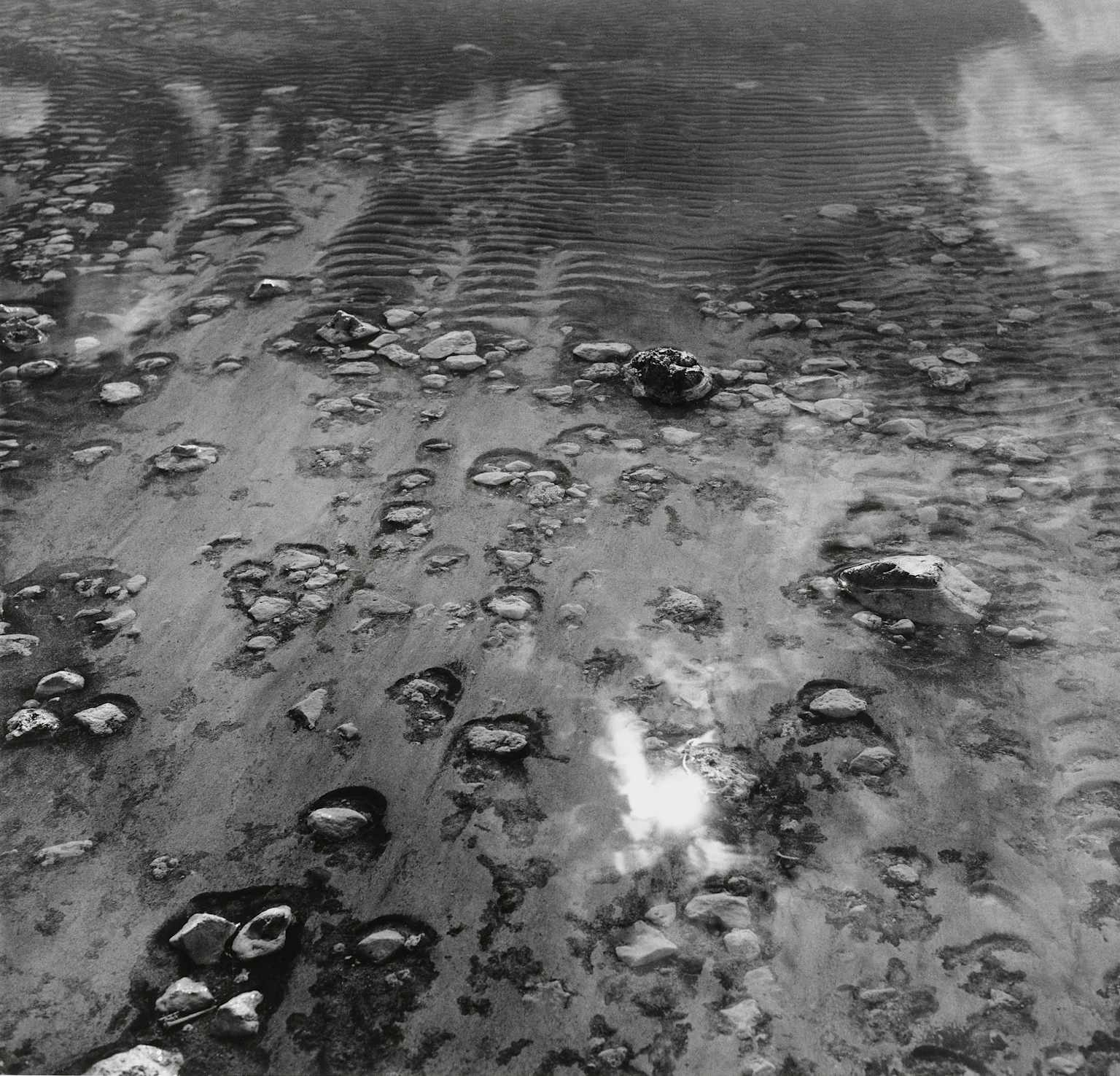
Sabi has to do with the old, but what it pursues is a beauty on which time has already left its signature.
Mono no aware: Rinko Kawauchi, Illuminance
Rinko Kawauchi’s work is clearly associated with everyday, fleeting and delicate moments, and a photograph from Illuminance works very well for Mono no aware. Her work has been described as an attention to daily life and the familiar, precisely the ground where this concept becomes most emotional.
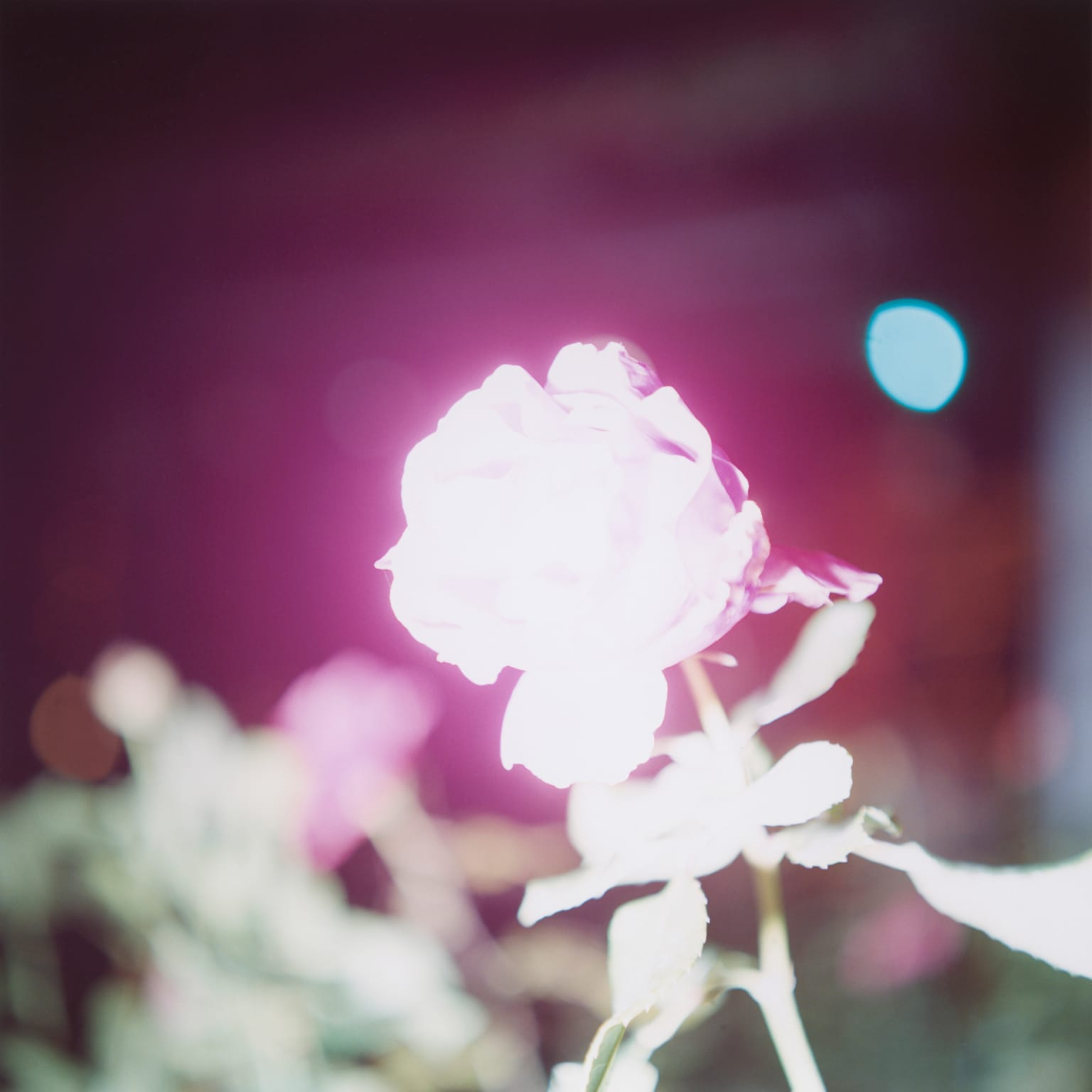
The gentle emotion of the ephemeral, of what seems small but one day will be missing.
Yūgen: Hiroshi Sugimoto, Theaters
Hiroshi Sugimoto’s Theaters series began in 1978 and is built from exposures lasting the full length of a film, leaving the screen as a mass of light and the rest of the space suspended in a kind of silent mystery. That mechanism fits Yūgen very well because it suggests more than it explains.
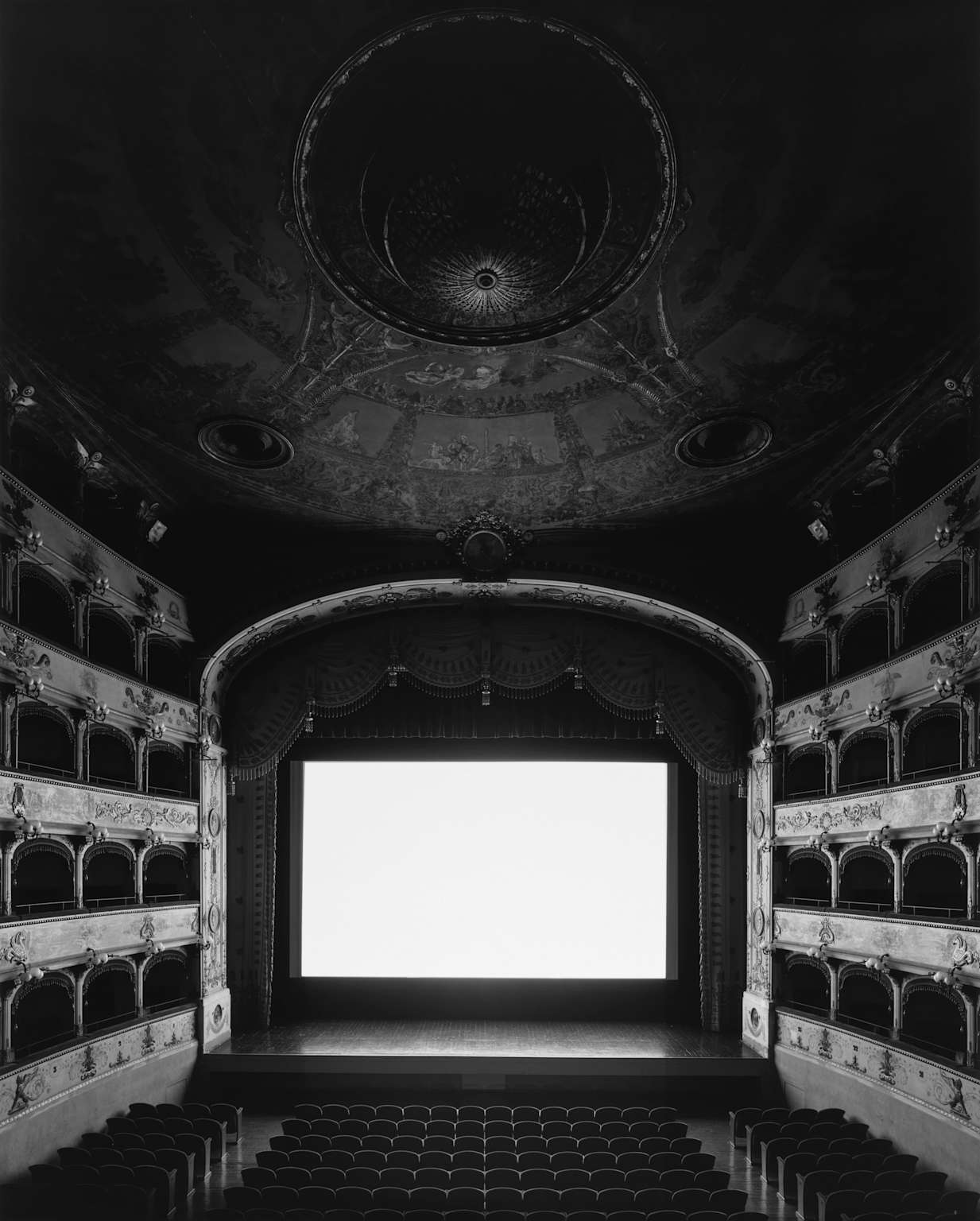
Here the photo takes a while to exhaust itself. It leaves an active void, an almost metaphysical presence, and forces you to look beyond the literal.
Fukinsei: Daido Moriyama, Stray Dog, Misawa
Stray Dog, Misawa is one of Daido Moriyama’s best-known photographs and was taken in 1971. For Fukinsei, it seems to me a very powerful reference because of its visual tension, its living imbalance and that sense of untamed form that remains precise.
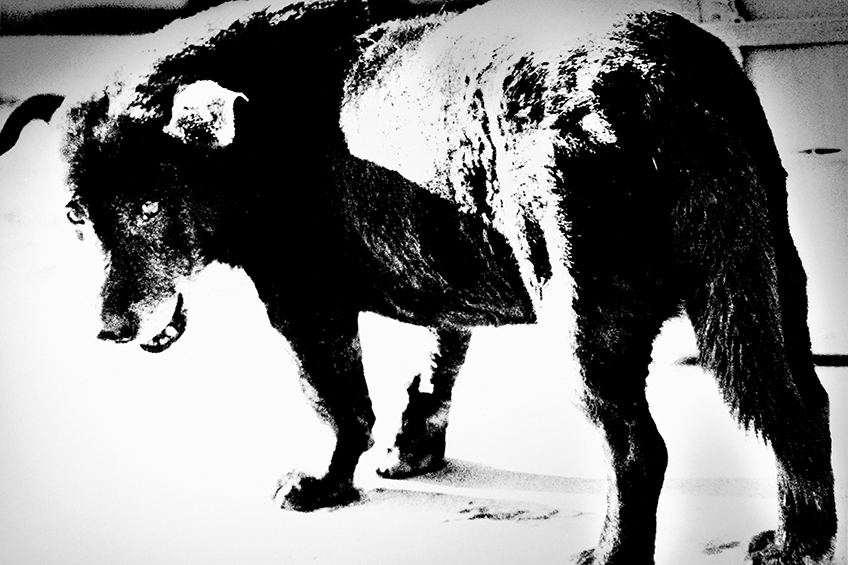
Asymmetry is a way of keeping the image open, nervous and breathing, without falling into disorder.
Closing
These concepts propose a discipline of attention, which is something very different from a decorative aesthetic or an exotic visual formula.
The broken photo, far from being a failed photo, accepts that reality does not need to become perfect to be meaningful.
Seeing better means seeing what was already there more clearly, without adding anything more.
Further reading
THE site: https://www.miguelitor.net/
There is no better course than Miguel’s.
Japanese street photography (in Spanish)
La Calle es Nuestra: Wabi-Sabi (in Spanish)
| Book | Why it is worth it | Concepts |
|---|---|---|
| Wabi-Sabi for Artists, Designers, Poets & Philosophers, Leonard Koren | One of the most cited books for getting into wabi-sabi; it frames it as the beauty of the imperfect, impermanent and incomplete. | Wabi, Sabi. Google Books |
| In Praise of Shadows, Jun’ichirō Tanizaki | Very useful for going deeper into shadow, half-light, suggestion and the refinement of what is not fully shown, so it opens up Yūgen very well. | Yūgen, Wabi. |
| Wabi Sabi: The Japanese Art of Impermanence, Andrew Juniper | A more developed introduction to the philosophy and spirituality of wabi-sabi, with history, culture, art and design. | Wabi, Sabi, Mono no aware. |


Deja una respuesta